Co-Located Events:
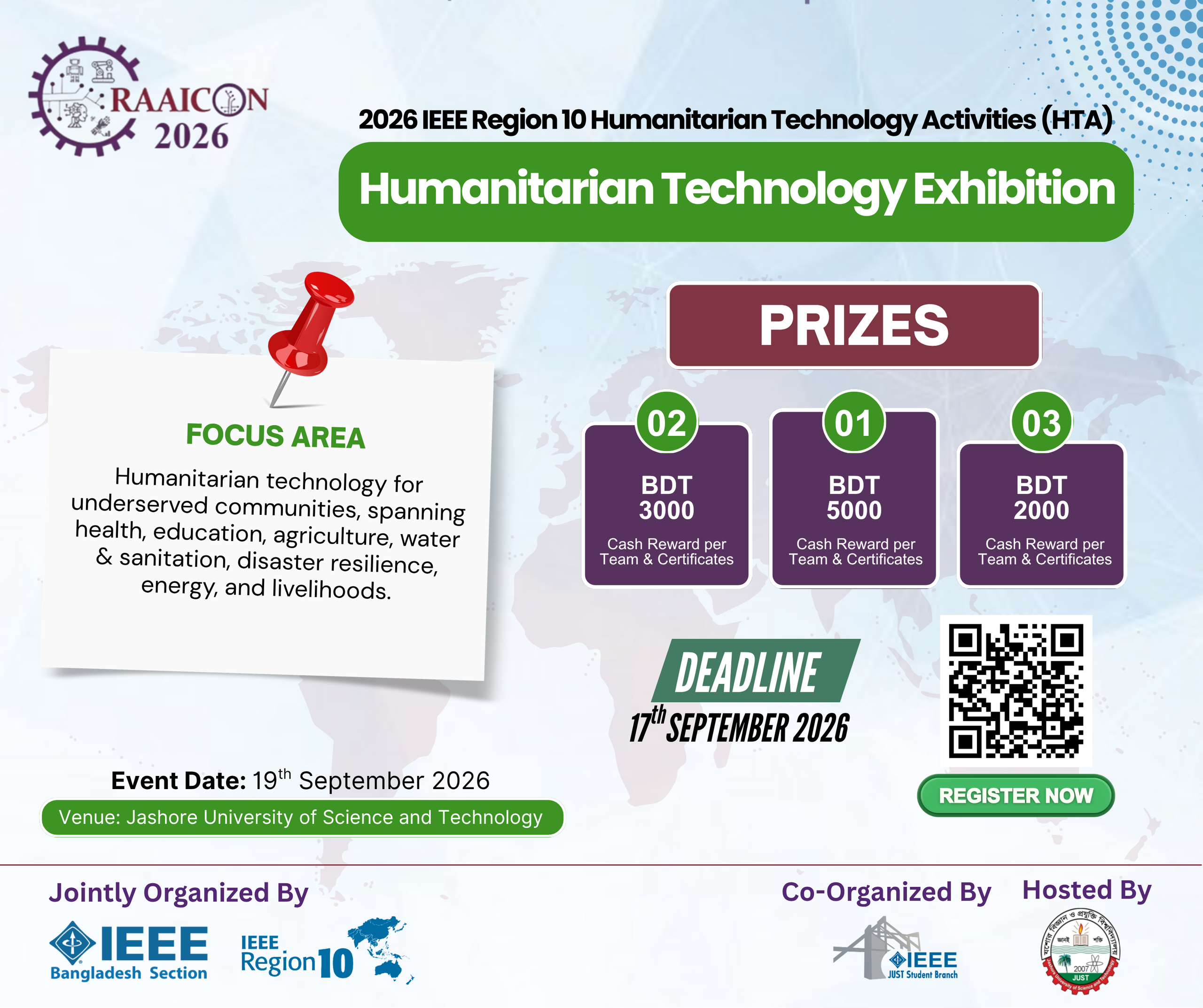
2026 IEEE Region 10 Humanitarian Technology Activities (HTA)
Humanitarian Technology Exhibition & Volunteer Training Program
The proposed IEEE R10 Humanitarian Technology Activities (HTA) project is intended to address critical needs within our local community by leveraging appropriate and sustainable technologies to improve quality of life and community resilience. Many underserved communities in our region continue to face challenges related to limited access to technical knowledge, digital resources, and sustainable practices. This project aims to bridge these gaps through practical, low-cost, and community-oriented technological activities supported by engineering expertise and volunteer engagement.
The initiative will also emphasize sustainable development by promoting technology-enabled solutions, local capacity building, and knowledge transfer to ensure long-term benefits. Through training, awareness programs, and hands-on activities, the project will empower students, educators, youth, and community members to adopt innovative approaches for solving local challenges.
Alongside IEEE RAAICON 2026, this humanitarian project exhibition will be conducted following the volunteer training program, where a panel of judges will assess each project. A certificate will be issued to every participant, and awards will be granted to the top three project teams.
At a Glance
- Date: September 19, 2026
- Venue: Jashore University of Science and Technology, Jashore 7408, Bangladesh
- Organized by: IEEE Region 10 · Bangladesh Section
- Co-Organized by: IEEE JUST Student Branch
- Events: Held alongside IEEE RAAICON 2026
- Team size: 1 to 5 members
- Focus: Humanitarian technology for underserved communities, spanning health, education, agriculture, water & sanitation, disaster resilience, energy, and livelihoods
Why This Event Exists
Across Bangladesh and the wider Region 10, many communities still face limited access to essential services, such as healthcare, clean water, reliable energy, education, and economic opportunity. This IEEE Region 10 Humanitarian Technology Activities (HTA) project asks students to bridge these gaps with practical, low-cost, community-oriented engineering.
The work is explicitly framed around the UN Sustainable Development Goals; not a single goal, but the broader set that touches underserved and marginalized communities: good health and well-being (SDG 3), quality education (SDG 4), clean water and sanitation (SDG 6), affordable and clean energy (SDG 7), decent work and economic growth (SDG 8), reduced inequalities (SDG 10), sustainable communities (SDG 11), and climate action (SDG 13).
Projects are judged on whether they could genuinely improve lives, widen access to essential services, or address a socio-economic or environmental challenge in an underserved setting.
Why Take Part
Open to engineering, science, and social-development-minded students with an interest in humanitarian work, whether the idea is a health device, an education tool, a livelihood platform, or a disaster-response system.
- Show your work: Present to academics, industry experts, and humanitarian professionals, and get judged feedback you can act on.
- Share ideas: Trade approaches with students and researchers from universities across Bangladesh and Region 10 working on similar problems.
- Learn from experts: Technical workshops and industry-focused sessions delivered by distinguished IEEE and academic speakers.
- Win prizes: Prize money and certificates for the champion and runners-up, awarded at the closing ceremony.
- Get certified: Every participant receives an official certificate recognizing their participation.
- Build your network: Meet IEEE leaders, humanitarian professionals, researchers and students from across Region 10.
Program — Three Segments
Segment 1 — Volunteer Training Program
Session I — Humanitarian Project Design
The key aspects of designing a humanitarian project that is both innovative and sustainable, from problem framing within a community’s real socio-economic context to a solution the community can keep running on its own.
Speaker: Prof. Shaikh A Fattah
Session II — Technology-Driven Solutions for Underserved Communities
Using appropriate technology, low-cost digital tools and community training to improve education, agriculture, healthcare awareness, disaster resilience, clean energy access and digital/financial literacy across SDG themes rather than one sector alone.
Speaker: Prof. Celia Shahnaz
Segment 2 — Humanitarian Project Exhibition
For teams exhibiting a working prototype, model, or project that tackles a socio-economic, environmental, or public-service challenge in an underserved community. A panel of judges evaluates every project; certificates go to all participants and prizes go to the top three teams.
- Presentation mode: Oral presentation, plus a live demonstration where the project allows it.
- Team size: Minimum 1 member, maximum 5 members per team.
- On the day: Bring a fully functional prototype. Winners are announced at the closing ceremony.
Focus Areas
- Low-cost healthcare & diagnostic devices for underserved communities
- Assistive & accessibility technologies for persons with disabilities
- Agricultural technology & food security solutions
- Clean water, sanitation & affordable/renewable energy solutions
- Disaster response, early-warning & resilience systems
- Education & digital-literacy tools for underserved learners
- Livelihood & economic-empowerment technology
- Community informatics, data-for-good & digital inclusion platforms
- Rehabilitation, physiotherapy & mental health support tools
- Wearable & remote health-monitoring systems
Segment 3 — Keynote & Invited Talks
Keynote I — Introduction to Humanitarian Technologies
How the IEEE Humanitarian Technology Board inspires and equips volunteers worldwide to run humanitarian technology activities at a local level, across the full range of SDGs.
Speaker: To be announced later
Keynote II — Empowering IEEE Volunteers
Operations of IEEE SIGHT — using technology for sustainable development in partnership with underserved communities and local organizations, beyond any single sector.
Speaker:To be announced later
Keynote III — Impact of Humanitarian Technologies on Local Communities
Designing scalable solutions aligned with the UN SDGs by strengthening grassroots capacity and building a supportive ecosystem around underserved communities in Bangladesh and Region 10.
Speaker: To be announced later
Prizes for the Top Three Teams
Every winning team receives prize money and a certificate. All participants receive a certificate of participation.
- Champion: BDT 5000 — prize money & certificate
- 1st Runner-up: BDT 3000 — prize money & certificate
- 2nd Runner-up: BDT 2000 — prize money & certificate
Registration — Fees by Category
Fees are per participant. Teams may have up to 5 members..
| Participant Category | Regular Deadline: 17th September, 2026 | Eligibility |
| IEEE Student Member | 100 BDT | Must be a registered IEEE Student Member |
| Non-IEEE Student | 200 BDT | Open to all non-IEEE students |
| IEEE SB Executive Committee | 100 BDT | Chair, Vice Chair, Secretary, or Treasurer of an IEEE Student Branch or Student Branch Chapter |
| RAAICON 2026 Participant | 100 BDT | Registered student author/ participant for IEEE RAAICON 2026 |
Registration Process:
Step 01: Send the applicable registration fee via bKash (Send Money) to 01914066284, and keep the Transaction ID and a screenshot of the payment. For teams with more than one member, only team leaders of each team need to register for the event and must provide information of other team members.
Step 02: Visit https://forms.gle/QSY2DShfxRSPgHqX6 and fill up the registration form with valid information. Once submitted, a confirmation email will be sent, and your participation will be finalised upon verification.